
Market and inventory check: September 26, 2026. This article separates broad memory-market conditions from the availability of specific components.
A memory shortage is not one single market. AI infrastructure can put pressure on DRAM and enterprise NAND capacity while an industrial buyer faces a different problem: finding the exact SDRAM, SRAM, NOR Flash or EEPROM fitted to an existing board. A device with the same capacity is not automatically a replacement, and an industry shortage headline does not prove that a particular part number is unavailable.
For teams maintaining long-life equipment, the practical response is to identify the exact device, check available lots and documentation, and qualify any change before committing production. Below, we explain the market context and highlight 20 memory-related part numbers currently listed in ZZX Electronics’ inventory.
What is driving the memory shortage discussion in 2026?
In its September 21 update, TrendForce reported stronger North American enterprise SSD demand, including both TLC and QLC products, and expected continued upward price pressure in the fourth quarter. Its July 3 analysis also described tight DRAM supply and suppliers prioritizing server demand. These reports concern specific market segments and forecasts; they are not live quotations for legacy components.
The distinction matters. An enterprise SSD uses a controller, firmware and a qualified NAND configuration. A loose NAND component for an older embedded design is a different procurement item. Likewise, HBM used by AI accelerators does not replace SDR SDRAM or asynchronous SRAM on an industrial controller.
Supply conditions can also diverge over time. TrendForce’s July 30 outlook identified a potentially different supply trajectory for DRAM and NAND in 2027. That is a forecast, not a guaranteed recovery date. Buyers should evaluate the relevant technology, manufacturer and exact ordering code instead of assuming every memory family will move together.
For legacy equipment, compatibility is often the real constraint
A purchasing team may find plenty of “memory chips” and still have no usable supply for its approved bill of materials. Package, voltage, organization, timing and firmware requirements can eliminate apparently similar alternatives. A repair order may need only 20 devices, but those 20 must be the right devices.
- DRAM: SDR SDRAM, DDR2 and DDR3 are separate generations. Matching capacity alone does not establish controller, electrical or timing compatibility.
- SRAM: asynchronous and synchronous devices serve different interfaces. Confirm organization, access timing and control signals rather than treating all SRAM as interchangeable.
- NAND Flash: check the controller’s supported geometry, page and spare-area layout, ECC requirements and device identification. A nominally similar density can still require firmware changes.
- NOR Flash: confirm the interface, supply voltage, command set and erase layout. Serial and parallel NOR are not interchangeable solely because both store firmware.
- EEPROM and configuration memory: check addressing, programming requirements and the consuming device. A configuration PROM is not general-purpose working RAM.
Keep the complete suffix in every enquiry. Temperature grade, package and revision details should not disappear when data moves from a spreadsheet into a quotation. Our part-number suffix guide explains why a shorter search term is not a purchase specification.
Selected memory and Flash inventory at ZZX Electronics
The following quantities were read from our website’s inventory records on September 26, 2026. They are a dated listing snapshot, not reserved allocations or proof that these individual models are experiencing a market-wide shortage. Follow each part-number link and request confirmation of the available lot, condition, documentation, current quantity and shipment terms before ordering.
The groups below describe device families, not approved substitute groups. We have deliberately left prices out of this article so that an old Blog post does not become an outdated quotation.
NAND Flash
| Exact part number | Listed quantity (pcs) |
|---|---|
| MT29F64G08AJABAWP-IT:B | 3,000 |
| MT29F32G08AFABAWP-IT:B | 126 |
| MT29F1G08ABBDAH4-IT:D | 40 |
| MX30LF1G08AA-TI | 219 |
NOR Flash
| Exact part number | Listed quantity (pcs) |
|---|---|
| MX25L1606EM1I-12G | 18,585 |
| M25P128-VMF6PB | 314 |
| MX66L51235FMI-10G | 7 |
| MT35XU512ABA1G12-0AUT | 100 |
DRAM: SDR SDRAM, DDR2 and DDR3
| Exact part number | Listed quantity (pcs) |
|---|---|
| MT48LC8M16A2P-75IT | 5,000 |
| MT48LC16M16A2TG-75IT | 178 |
| MT47H64M16HR-3:H | 464 |
| MT41J64M16JT-15E:G | 155 |
SRAM
| Exact part number | Listed quantity (pcs) |
|---|---|
| IDT71256S25TDB | 1,738 |
| IDT71256S70DB | 72 |
| CY7C1470BV33-167AXI | 497 |
Serial EEPROM
| Exact part number | Listed quantity (pcs) |
|---|---|
| M95128-DRMN3TP/K | 9,200 |
| AT24C512C-MAHM-T | 5,000 |
| CAT24C32WI-GT3 | 130 |
EPROM and FPGA configuration PROM
| Exact part number | Listed quantity (pcs) |
|---|---|
| M27C512-12F1 | 24 |
| XCF32PFSG48C | 620 |
The first two DRAM listings are SDR SDRAM; MT47H64M16HR-3:H is a DDR2 device and MT41J64M16JT-15E:G is a DDR3 device. In the final group, M27C512-12F1 is EPROM, while XCF32PFSG48C is Platform Flash configuration memory. Neither should be presented as a replacement for the DRAM or NAND devices above.
These are selected examples rather than our complete catalogue. Browse the Memory category or send the complete manufacturer part number if your required device is not shown. Listing a model here does not establish lifecycle status, manufacturer authorization, traceability or qualification for a particular application; those points must be checked for the offered lot.
MRAM: a separate nonvolatile memory category
For applications reviewing nonvolatile parallel memory, see the exact-code specifications for Everspin MR2A16AVYS35 4 Mbit MRAM and Teledyne e2v EV2A16AMNYU35 4 Mbit MRAM. These are separate ordering codes, not an approved substitute pair. Compare supply, pinout, timing, temperature and qualification requirements before proposing a replacement. These links are technical procurement examples added October 24, 2026, not part of the September inventory-quantity snapshot above.
How to source scarce memory without creating a new production risk
1. Freeze the exact technical requirement
Start with the approved BOM, board revision and original manufacturer documentation. Record the full ordering code, required quantity and delivery window. If an alternative is acceptable, engineering should define the permitted differences before purchasing requests quotations. “Same size” and “same number of pins” are not sufficient acceptance criteria.
2. Distinguish listed stock from an available, documented lot
Ask whether the quotation is based on stock held by the seller or stock that must be sourced. Request the available quantity, lot and date-code details, packaging information and relevant photographs. Agree the documentation that will accompany shipment. A searchable inventory entry is a starting point for verification, not a substitute for it.
3. Match inspection and testing to the risk
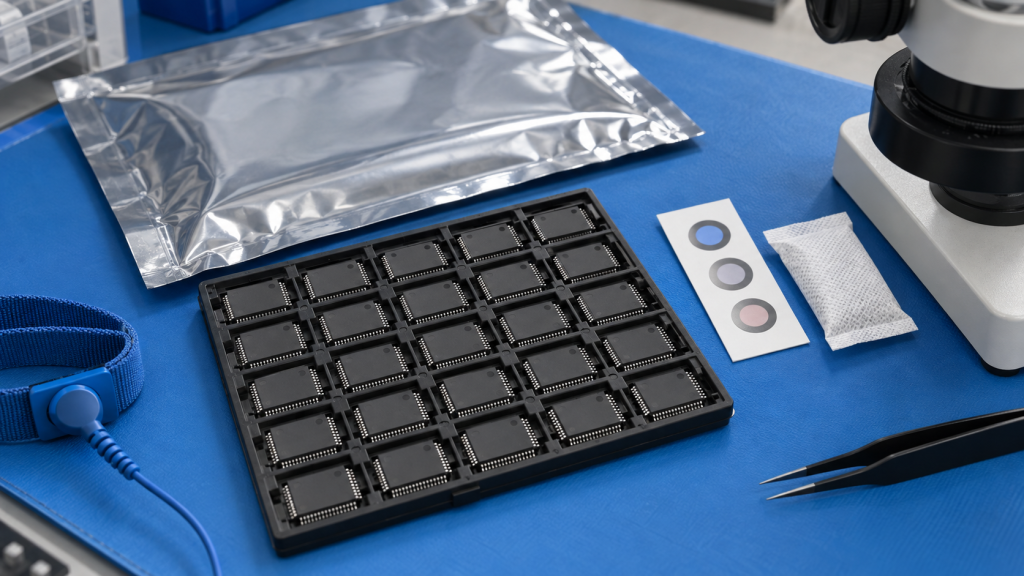
For older inventory, review packaging and storage information as well as external condition. Define any necessary inspection, electrical testing and acceptance criteria with the responsible engineering or quality team. A visual check alone cannot establish all electrical characteristics, remaining endurance or data-retention performance.
Do not infer that an older date code makes a part unusable, or that a newer marking proves authenticity. Our date-code and storage guide and documentation and traceability guide cover the questions to resolve before acceptance.
4. Check programming and system-level behavior
For programmable memory, clarify whether the required supply is blank, erased, preprogrammed or otherwise conditioned. Identify the approved image and programming method where relevant. Do not assume that a previously programmed device is ready for production simply because its package marking matches. Where substitution is proposed, validation belongs at the board and system level as well as the component level.
5. Buy against a demand plan, not a headline
Compare near-term production needs, repair obligations and engineering redesign options. Large speculative purchases can create storage, cash-flow and qualification problems of their own. For a confirmed end-of-life event, use the manufacturer’s actual notice and order deadlines to build a last-time-buy plan. A broad market forecast is not an end-of-life notice for your part.
What to include in a memory-component RFQ
A useful enquiry gives the supplier enough information to distinguish a technically acceptable offer from a superficially similar one. Include:
- The exact manufacturer part number, including punctuation and suffixes.
- Required quantity, delivery destination and required arrival date.
- Any restrictions on date codes, lot splits, packaging and component condition.
- Required traceability documents, inspection scope and testing requirements.
- Programming requirements for nonvolatile devices, where applicable.
- Whether engineering-approved alternatives may be proposed or only the exact part is acceptable.
Use our RFQ checklist to prepare the request. For the models above, open the corresponding inventory page or contact ZZX Electronics with your BOM and sourcing constraints. We can review the listed availability and discuss the information needed for a written quotation.
Frequently asked questions
Does the 2026 memory shortage mean every Flash chip is unavailable?
No. Supply conditions differ by technology, density, manufacturer and ordering code. Enterprise SSD demand is useful market context, but it does not establish availability for a specific serial NOR or legacy NAND device. Check the exact component and lot.
Can a higher-density memory device replace a lower-density one?
Not automatically. The controller, address mapping, interface, voltage, package, timing and software or firmware support must be checked. A capacity increase is an engineering change, not a procurement shortcut.
Are EEPROM, SRAM and Flash the same type of memory?
No. They differ in operation and intended use. For example, Microchip identifies AT24C512C as serial EEPROM, while the Renesas 71256 documentation describes static RAM. Use the original device documentation to establish requirements.
Are the inventory quantities in this article live?
No. They are a snapshot checked on September 26, 2026. Quantities may change after publication. Confirm the current available quantity and offered lot through the part-number page and a written quotation.
Sources and technical references
- TrendForce, September 21, 2026: enterprise SSD demand and fourth-quarter outlook.
- TrendForce, July 3, 2026: third-quarter DRAM and NAND market outlook.
- TrendForce, July 30, 2026: differing DRAM and NAND supply outlooks.
- Macronix MX30LF1G08AA NAND Flash datasheet.
- Renesas 71256S/L SRAM datasheet.
- STMicroelectronics M95128 automotive serial EEPROM datasheet.
- Microchip AT24C512C product documentation.
Market commentary is dated and is not a price forecast by ZZX Electronics. Product examples are not interchangeability recommendations. Final technical acceptance should follow the applicable manufacturer documentation and the buyer’s engineering and quality requirements. Illustrations are AI-generated editorial imagery, not photographs of offered stock or ZZX facilities.