A quote arrives with the right-looking IC family but a different ending on the part number. Is the change just a reel size, or does it mean a different footprint, accuracy grade or operating temperature? For a buyer supporting legacy equipment, that distinction can decide whether the order is usable.
There is no universal suffix dictionary for electronic components. The same letter can mean different things across manufacturers and product families. Start with the complete manufacturer ordering code—not a shortened inventory description—and verify each difference against the relevant ordering guide.
Quick Answer: Can You Ignore a Part Number Suffix?
Do not ignore a suffix until you have verified what it changes. It may identify the package, electrical or speed grade, temperature range, screening level, lead finish or shipping format. Compare the exact manufacturer codes and obtain engineering approval for any substitution. A matching base number alone does not establish interchangeability.
The examples below explain ordering conventions; they are not claims that every example device is obsolete or currently stocked by ZZX Electronics.
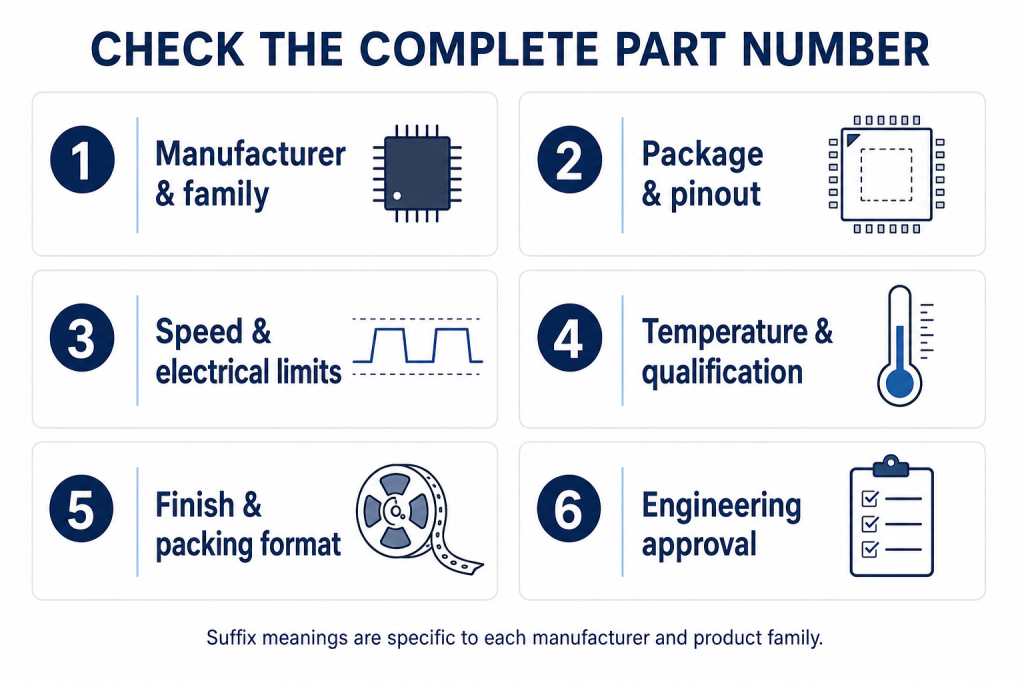
1. Separate the Six Checks Before Comparing Prices
| Check | What to compare | What a mismatch can mean |
|---|---|---|
| Manufacturer and family | Original manufacturer, full base number and relevant revision | A similar name may identify a different device or an unapproved second source. |
| Package and pinout | Package drawing, dimensions, pitch, pin count and pin assignments | The part may not fit the board, even with the same number of pins. |
| Speed and electrical limits | Timing, voltage, accuracy and other application-critical specifications | The device may fit physically but fail the design requirements. |
| Temperature and qualification | Rated range, ambient versus junction limits, screening and required grade | The offered variant may not meet the environmental or acceptance requirements. |
| Finish and packing format | Lead or ball finish, tube/tray/reel, orientation and supplied quantity | The assembly process or handling plan may need review. |
| Engineering approval | Approved BOM entry and documented disposition of each difference | A proposed alternate remains unapproved, regardless of price or availability. |
Ask the supplier to identify the offered ordering code explicitly. A quotation that repeats only your requested number, while a label photo shows something else, leaves the most important question unresolved.
2. Three Manufacturer Examples: Similar Numbers, Different Decisions
TI: Same function and pin count, different packages
Texas Instruments lists SN74LVC1G14DBVR in the 5-pin SOT-23 package, drawing code DBV, and SN74LVC1G14DCKR in the 5-pin SC70 package, drawing code DCK. Both belong to the same Schmitt-trigger inverter family, but their package designations are different. “Five pins” is not enough to approve the same footprint. Compare the drawings before accepting a change. Sources: TI’s DBVR ordering page and DCKR ordering page.
The TI data sheet also distinguishes shipping options: the DBVR ordering row specifies 3,000 units on a large tape-and-reel, while DBVT specifies 250 on a small tape-and-reel. This is a family-specific example, not a rule that every “R” or “T” means the same thing. A distributor’s cut quantity also does not change the manufacturer’s original order code.
Analog Devices: Same package, different accuracy grades
Analog Devices lists AD590JH and AD590KH in the same 3-pin TO-52 package. However, its AD590 specification table gives different maximum calibration errors at 25°C: ±5°C for the J grade and ±2.5°C for the K grade under the stated test conditions. The common package does not make the accuracy requirements identical. Source: AD590 Rev. G, Table 1 and Ordering Guide.
Our separate listing for AD590JH/883B includes an additional qualification suffix. Do not drop that suffix or treat the catalog AD590JH example as evidence that the qualified version can be replaced. Confirm the exact grade and required documentation for the approved BOM.
AMD: Speed, package and temperature are separate fields
AMD’s Zynq-7000 overview separates speed grade, package identification, pin count and temperature grade in its ordering diagram. For XC7Z020-2CLG484I, retaining just “XC7Z020” loses information needed to identify the ordering variant. DS190 identifies the industrial I grade with a junction-temperature range of −40°C to +100°C; that is not an ambient-temperature guarantee. Source: AMD DS190, Table 7 and Figure 4.
Do not invent a replacement ordering code by swapping a suffix. The manufacturer’s available combinations still need checking, and the selected part must meet the design’s timing and thermal requirements.
3. Why Legacy Inventory Needs Extra Care
Older inventory may be described using a base family, a former manufacturer’s name, an internal stock number or a shortened label. Keep the original evidence separate from a normalized purchasing description. Never silently delete a slash, hyphen, decimal point or parenthetical code just to make two spreadsheet entries match.
When two codes appear together, establish the relationship from a manufacturer document. They might represent a commercial code and a specification-based designation, or simply a packaging or option suffix. Punctuation alone cannot tell you which. If the supplied code is truncated or cannot be resolved, hold that line for clarification rather than filling in the missing characters.
Also check the relevant product-change and end-of-life notices. For example, Microchip’s PCN/EOL policy covers changes affecting form, fit or function as well as obsolescence. A family name that has stayed the same does not replace review of the notices applying to the exact item. Source: Microchip PCN/EOL Notification Policy.
Lot age is a different question from ordering-code identity. Once the variant is established, use our date-code and storage-risk guide to plan the handling and condition review.
4. A Five-Step Workflow for an RFQ or Alternate Offer
- Freeze the requirement. Record the approved manufacturer’s full part number, required quantity and delivery date. Identify any mandatory grade, packaging or traceability conditions before comparing offers.
- Capture the offered identity. Ask for the complete offered number and available package-label photographs. Preserve both the requested and offered values; do not overwrite one with the other.
- Build a difference list. For each changed character or suffix, record the manufacturer’s explanation, document revision and relevant specification. An unresolved difference is a question to answer, not a match.
- Route the decision correctly. Procurement can document availability and commercial terms. Engineering and quality should review technical suitability and acceptance requirements. “Supplier says equivalent” is not a completed approval record.
- Carry the decision into the order. State the accepted full code and any approved deviation on the purchase order. On receipt, reconcile the delivered identification and records with that decision before releasing the parts for use.
If the full code cannot be confirmed, request clarification or a different offer. Do not let a low unit price or an urgent delivery date turn an unknown suffix into an assumed match.
5. Exact Identity Is Not the Same as Authenticity
A correct-looking part number is one check—not proof of origin or condition. TI warns that counterfeit markings and labels can resemble genuine products and recommends purchasing through TI or its authorized distributors. When a legacy requirement leads to independent sourcing, the buyer still needs a risk-based review of the supplier, available traceability, lot condition and agreed inspection or testing. Source: TI anti-counterfeit guidance.
Keep identity review and authenticity review as separate decisions. Our CoC, traceability and inspection-record checklist explains which supporting documents to request. No suffix decoder or generic product photo replaces that evidence.
Frequently Asked Questions
Does the same base part number mean two ICs are interchangeable?
No. It is a starting point for comparison, not approval. Check the complete ordering variants against the required package, pinout, electrical limits, temperature grade and qualification.
Can a tape-and-reel suffix be ignored for a small order?
Only after checking that exact manufacturer’s ordering table. Distinguish the original ordering option from how a distributor supplies a partial quantity. Record any change to packing or handling requirements.
Is a higher speed or wider temperature grade automatically acceptable?
No. One apparently improved specification does not approve the complete alternate. Check all design requirements and obtain the appropriate engineering and quality approval.
What if the supplier’s label and quote show different codes?
Ask the supplier to reconcile them before ordering. Keep both records and the explanation. Do not silently edit the label transcription to match the quote.
Can a top marking alone confirm the full orderable part number?
Do not rely on it alone. TI’s package addendum lists abbreviated top markings separately from full orderable numbers. Use the manufacturer’s marking information together with the package label and procurement records; none alone establishes authenticity.
Send the Complete Code With Your Sourcing Request
For an obsolete or hard-to-find component enquiry, send ZZX Electronics the exact part number, manufacturer, quantity and required delivery date. Include your package and grade requirements, any proposed alternate, and available label or BOM information. Please share only the material needed to identify the requirement, not confidential design files.
Request a quote from ZZX Electronics. Clearly identify whether an exact match is required or whether an alternate may be submitted for your engineering review.
Manufacturer References
- Texas Instruments: SN74LVC1G14 data sheet and package option addendum
- Analog Devices: AD590 data sheet, Rev. G
- AMD: Zynq-7000 SoC Overview, DS190 v1.11.1, ordering information
- Microchip: Product/Process Change and End of Life Notification Policy
- Texas Instruments: Anti-counterfeit guidance
Sources checked September 7, 2026. This article is a procurement checklist, not an engineering substitution approval. Use the applicable manufacturer documents and your organization’s acceptance process. Illustrations are AI-generated educational visuals, not photographs of specific offered stock or evidence of inspection.