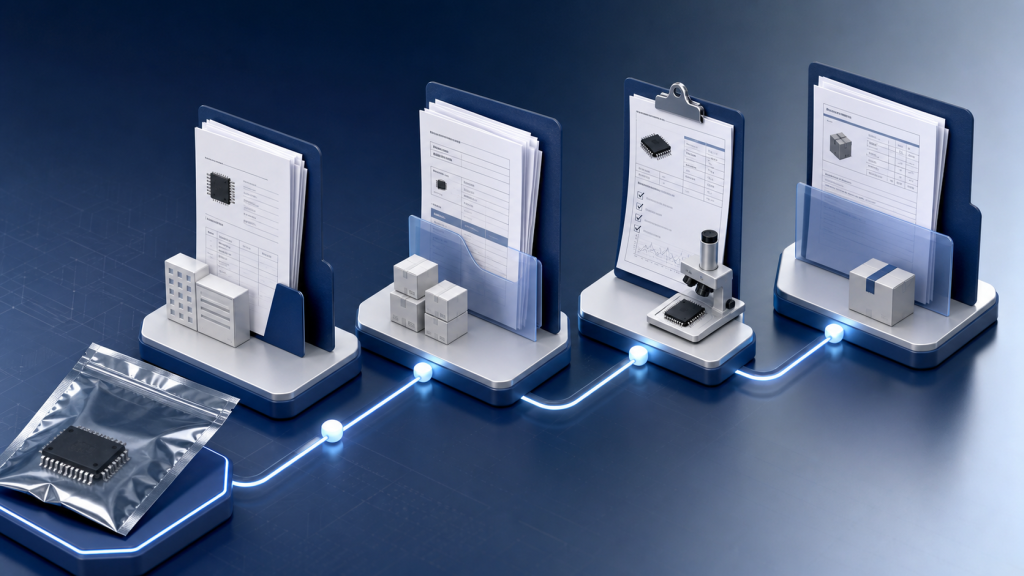
When an obsolete electronic component is no longer available through the original manufacturer or an authorized channel, the purchasing decision cannot rest on a product photo and a seller’s statement that the parts are “new and original.” The buyer needs a document package that links the physical lot to its identity, source, handling history and any inspection or testing performed.
The required depth depends on the application, contract and risk level. A replacement part for a non-critical repair does not necessarily require the same evidence as a lot intended for aerospace, defense, medical or other high-reliability hardware. Even so, the same basic principle applies: every important claim about the parts should be supported by a record that can be matched to the delivered lot.
Quick Answer: What Should the Documentation Package Include?
For obsolete or hard-to-find electronic components, buyers should normally request:
- The exact manufacturer and complete part number.
- Quantity, lot or batch information, date code and serial numbers where applicable.
- A supplier Certificate of Conformance identifying the transaction and delivered goods.
- Available traceability records showing the source and each relevant intermediary.
- Copies or photographs of original labels, packaging and moisture or ESD controls.
- An incoming inspection report tied to the same lot.
- Test reports when testing was required, including the method, sample size, acceptance criteria and result.
- Records of any nonconformance, rework, remarking concern or authorized deviation.
A Certificate of Conformance is useful, but it is not a substitute for chain-of-custody evidence or lot-specific inspection. Likewise, a laboratory report does not automatically prove where the parts came from.
1. Certificate of Conformance: What It Should Tell You
A Certificate of Conformance, commonly abbreviated as CoC or C of C, is the supplier’s formal statement that the delivered goods conform to the purchase-order requirements stated in the document. At minimum, a useful certificate should identify:
- The supplier’s legal name and address.
- The customer or ship-to party.
- The purchase-order or invoice reference.
- The exact manufacturer and part number.
- Quantity shipped.
- Lot, batch, date-code or serial-number information when available.
- Applicable specification or quality level when contractually required.
- A conformance statement, issue date and authorized signature or approval.
The wording alone is not enough. The identifiers on the CoC must agree with the packing list, package labels, inspection report and physical device markings. A document that says only “electronic components conform” without identifying the actual lot has little value in a later investigation.
NASA/JPL institutional requirements illustrate the importance of connecting certificates to specific lots: flight-part records are expected to identify the manufacturer, part number and lot or lot date code, while relevant conformance and test data are retained for the project’s defined period. Those requirements are not universal commercial rules, but they demonstrate what strong traceability looks like in a high-reliability program.
2. Traceability and Chain of Custody Are Not the Same as a CoC
Traceability answers a different question: How did this particular lot move from the original manufacturer to the company supplying it now?
For material sourced outside an authorized channel, a traceability package may include original manufacturer labels, authorized-distributor invoices, packing lists, transfer records and certificates issued by each intermediary. JPL’s current original-component-manufacturer traceability clause requires certificates to identify the intermediaries between the original manufacturer and the final subcontractor. This is a useful model for buyers designing their own risk-based requirements.
There are several levels of evidence:
- Full manufacturer traceability: Documentation connects the lot back to the original component manufacturer without an unexplained gap.
- Partial traceability: Some earlier records exist, but one or more transfers cannot be independently documented.
- Supplier traceability only: The current supplier documents its own receipt and sale, but the earlier chain is unavailable.
- No documentary traceability: Identity must be evaluated through inspection and testing, with the remaining provenance risk stated clearly.
Partial traceability does not automatically mean a part is counterfeit. It does mean the buyer has less evidence and should adjust inspection, testing, approval and commercial terms accordingly.
3. Preserve Original Packaging and Labels
Original packaging can contain information that is missing from the part marking or CoC, including production lot codes, inspection codes, country of origin, quantity, packing date, moisture-sensitivity information and manufacturer-specific identifiers.
NASA’s Lesson Learned 982 explains why discarding original containers can break lot traceability: package labels may preserve production information that is not repeated elsewhere. For incoming inspection, buyers should therefore retain the packaging or capture clear, controlled images of every relevant label before repacking or kitting.
Check that:
- Label part numbers match the purchase order and physical devices.
- Quantities reconcile across labels, packing lists and received material.
- Lot and date-code information is consistent or any mixture is disclosed.
- Barcodes and human-readable fields agree.
- Moisture-barrier bags, desiccant, humidity indicators and ESD packaging are appropriate to the component and condition.
- There are no unexplained over-labels, removed labels or inconsistent fonts and formats.
Date code alone is not proof of authenticity. It is one identifier within the larger evidence package.
4. What an Incoming Inspection Report Should Contain
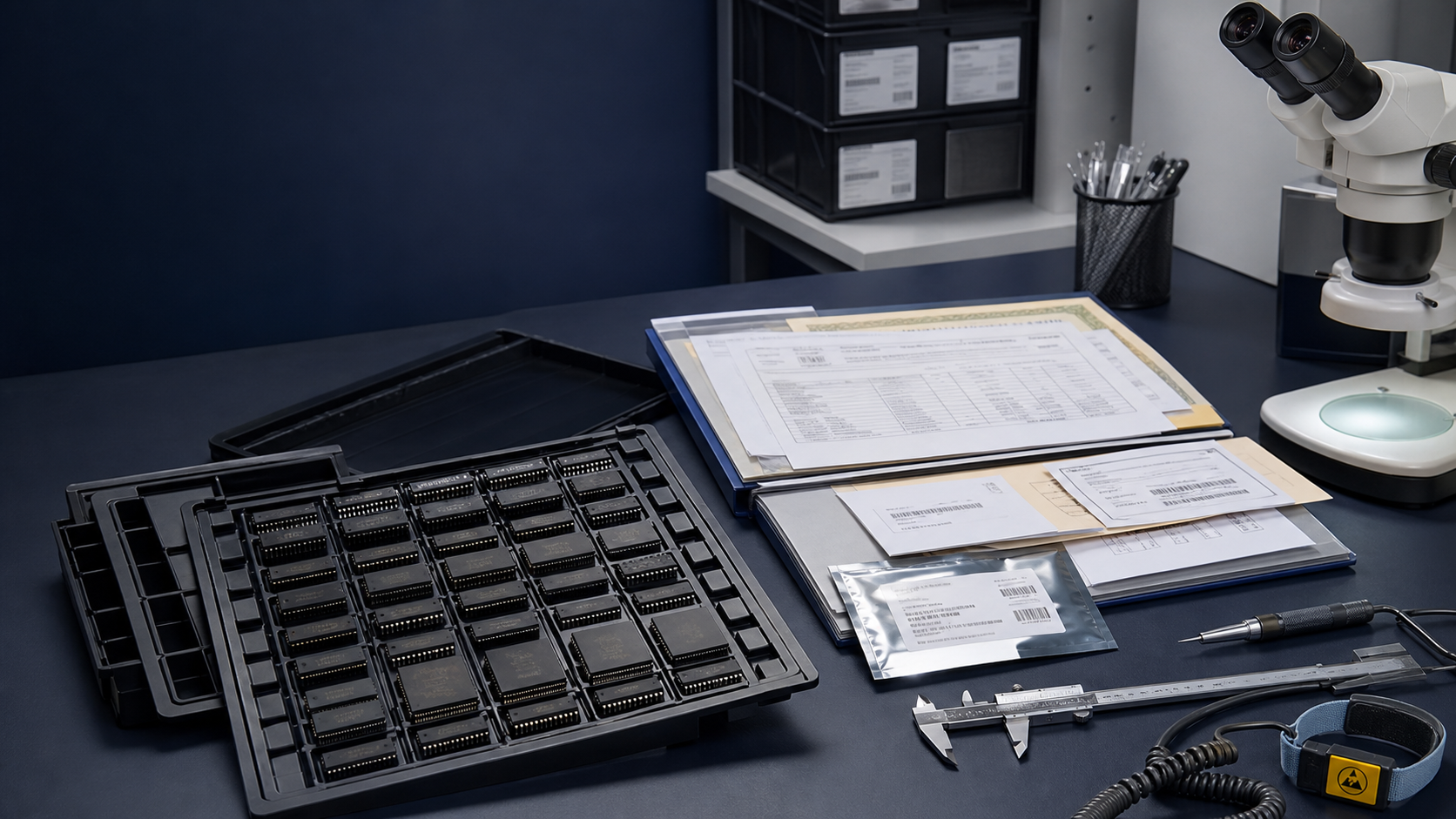
An inspection report should be lot-specific and reproducible. A useful report records:
- Supplier, purchase order, part number, quantity and lot/date codes.
- Quantity inspected and sampling basis.
- Packaging and label observations.
- Device marking, dimensions, lead condition and package condition.
- Magnification or equipment used where relevant.
- Photographs that can be tied to the inspected lot.
- Acceptance criteria, findings, disposition and reviewer approval.
The report should distinguish facts from conclusions. “Marking layout differs from the available manufacturer reference” is an observation. “Counterfeit” is a disposition that may require additional evidence and a defined escalation process.
For high-risk purchases, visual inspection may be only the first stage. X-ray, XRF, marking-permanency evaluation, solderability, decapsulation or electrical testing may be considered based on package type, source risk, application and contractual requirements. SAE AS6171 defines standardized counterfeit-detection test methods, while AS6081A addresses risk controls used by independent distributors. A buyer should specify the applicable method and revision rather than asking vaguely for “full testing.”
5. How to Read a Test Report Without Overestimating It
A test report is only meaningful when its scope is clear. Before accepting one, verify:
- The report identifies the same part number and lot as the delivered material.
- The laboratory or inspection organization is named.
- The test method and document revision are stated.
- The sample size and selection method are recorded.
- Equipment and relevant calibration status are identified.
- Acceptance criteria are defined before the result.
- Raw observations or images support the summary where appropriate.
- Failures, anomalies and deviations have not been omitted.
A passing sample does not prove that every unit in a large lot is identical. It supports a risk decision within the limits of the sampling plan and method. The buyer should also avoid treating an electrical functional test as proof of provenance: a device can operate correctly while still having uncertain origin, prior use or incorrect screening grade.
6. A Risk-Based Documentation Matrix
| Evidence | Routine industrial repair | Obsolete production lot | Aerospace, defense or other high-reliability use |
|---|---|---|---|
| Exact part number and manufacturer | Required | Required | Required |
| Supplier CoC | Recommended | Required | Required, with contract flow-down |
| Lot/date-code record | Recommended | Required | Required where applicable |
| Original packaging/label record | Recommended | Required | Required or formally dispositioned |
| Chain-of-custody documents | Risk-based | Strongly recommended | Defined by contract and source risk |
| Incoming visual inspection | Recommended | Required | Required to the specified plan |
| Additional testing | As needed | Risk-based | Risk-based and contractually defined |
| Nonconformance and deviation records | Required if applicable | Required if applicable | Required with controlled approval |
This matrix is a procurement guide, not a substitute for the buyer’s quality system, engineering authority or contractual requirements.
7. Seven Questions to Ask Before You Approve the Lot
- Can every document be matched to the exact delivered part number and quantity?
- Are mixed date codes or lots clearly separated and disclosed?
- Does the supplier claim full manufacturer traceability, partial traceability or only its own transaction history?
- Are original labels and packaging available for review?
- What inspection was actually performed, on how many units and against which criteria?
- If a test report is supplied, does it identify the method, revision, sample and result?
- What happens if the buyer’s incoming inspection finds an inconsistency?
Put these requirements in the RFQ or purchase order before shipment. Asking for traceability after a disputed delivery is much harder than defining it during sourcing.
8. How ZZX Electronics Handles Documentation Requests
Documentation availability varies by lot and source. When submitting an RFQ to ZZX Electronics, buyers should state the required manufacturer, exact ordering code, quantity, date-code restrictions, traceability level, inspection scope and any contractual quality clauses. Our team can then confirm which records are available for the quoted lot and whether additional inspection or testing must be arranged before shipment.
Examples of inventory pages where lot-specific documentation matters include the JANTX2N6796 military MOSFET, BD429A-G ARINC 429 line driver, XC7Z020-2CLG484I industrial Zynq-7000 SoC and CY7C346-35RMB military EPLD. Each page identifies the exact ordering code, current stock, date code, technical data and RFQ path; lot-level records are confirmed for the material being quoted.
We do not recommend assuming that every older lot carries the same historical paperwork. The correct approach is to review the evidence for the specific material being offered and disclose any limitation before the buyer makes an acceptance decision.
Frequently Asked Questions
Is a Certificate of Conformance enough to prove an electronic component is authentic?
No. A CoC is a supplier’s conformance statement. Its value increases when it is tied to lot-specific traceability, original packaging, inspection evidence and a controlled transaction history. It should not be treated as standalone proof of authenticity.
What is full traceability for an obsolete electronic component?
Full traceability means the records connect the delivered lot back to the original component manufacturer through the relevant intermediaries without an unexplained break. The required documents depend on the contract and supply chain.
Can old date-code components still be acceptable?
Yes, depending on storage, handling, package type, solderability, moisture sensitivity, application and inspection results. Date code by itself neither proves failure nor guarantees acceptability.
Does a passing laboratory report eliminate supply-chain risk?
No. Testing can reduce specific technical risks within the test scope and sample. It does not automatically establish origin, screening grade, prior use or an unbroken chain of custody.
Should buyers always demand the same documentation package?
No. Documentation and testing should be proportional to application criticality, source, lot value, availability, package risk and contractual requirements. The acceptance plan should be agreed before purchase.
Conclusion
For obsolete components, the physical parts and the documentation package are two halves of the same delivery. A strong file connects the purchase order, exact ordering code, lot identifiers, source records, packaging, inspection and any testing without contradictions or unexplained gaps.
The goal is not to collect the largest possible stack of paperwork. It is to obtain evidence that is specific, consistent and useful if the lot must later be accepted, investigated or traced through a fielded system.
References
- SAE AS6081A — Counterfeit EEE Parts Avoidance for Independent Distribution
- NASA/JPL Component Engineering & Assurance — Parts Supply Chain
- JPL Institutional Parts Program Requirements, JPL-D-20348
- NASA Lesson Learned 982 — Retention of Traceability Data for EEE Parts
- JPL QC106b — Original Component Manufacturer Traceability
- DLA ASSIST — IPC-1782B Traceability Standard Record
Disclaimer: This article provides general procurement guidance and does not replace manufacturer instructions, contractual requirements, engineering qualification, legal advice or a customer-specific quality plan.