An end-of-life notice creates two purchasing risks: ordering too little to support the remaining program, or buying years of material before the requirement and acceptance plan are clear. A last-time buy should resolve that uncertainty, not simply move it onto a warehouse shelf.
This guide is for procurement and engineering teams supporting long-life equipment with obsolete or hard-to-find electronic components. It turns an EOL notice into a decision record: the exact affected part, the applicable deadlines, the quantity calculation, the approved sourcing route and the plan for using the stock.
Quick Answer: What Is a Last-Time Buy?
A last-time buy (LTB) is a final ordering opportunity for a component being discontinued. The LTB deadline and the last shipment or delivery deadline are separate dates. Use the latest manufacturer notice for the exact ordering code, calculate the remaining net requirement, and confirm the accepted quantity and delivery schedule with the supplying channel. A lifecycle label is not a stock reservation.
1. Verify the Notice Before Treating a Part as Discontinued
Save the manufacturer’s notice number, revision, issue date and affected-parts list. Match the full ordering code to the approved BOM, including package, speed, temperature and qualification suffixes. Do not make an EOL decision from the age of a family, a distributor search result or an abbreviated spreadsheet entry.
Texas Instruments distinguishes not recommended for new designs, last time buy and obsolete: NRND can remain available for existing designs, whereas LTB indicates discontinuation in progress. Those labels are not interchangeable. Source: TI product lifecycle definitions.
Likewise, not every change notice announces discontinuation. Microchip’s policy separates manufacturing changes, document changes and EOL notifications. Read the notification category and affected part numbers before escalating a routine revision into a final-buy event. Source: Microchip PCN/EOL Notification Policy.
If requested and offered codes differ, use our part-number suffix checklist before counting the offer as usable supply.
2. Record the Ordering Deadline and Delivery Deadline Separately
| Milestone | What the buyer should establish |
|---|---|
| Notice issued or revised | Which notice version and exact ordering codes apply to this requirement? |
| Last-time-buy deadline | By when must the supplier accept the final order, and what earlier internal approval cutoff is needed? |
| Last shipment or delivery deadline | What does the notice actually specify, and what schedule has the supplying channel confirmed? |
| Program support endpoint | How long must production, field service and repair requirements remain covered? |
Analog Devices’ general obsolescence section describes a 12-month final-order period and shipments for up to 18 months from the PDN date. This illustrates why the order and shipment dates must not be collapsed into one deadline. It is not a deadline for an unrelated manufacturer or a substitute for the applicable PDN. ADI also notes that a generic product page can cover several models; resolve model-specific status when needed. Source: ADI Product Life Cycle Information.
Ask the supplier to confirm the accepted quantity, packaging, delivery schedule and applicable cancellation or rescheduling conditions in writing. A quote, an open RFQ and an accepted purchase order are different stages. Do not treat unconfirmed quantities as secured supply.
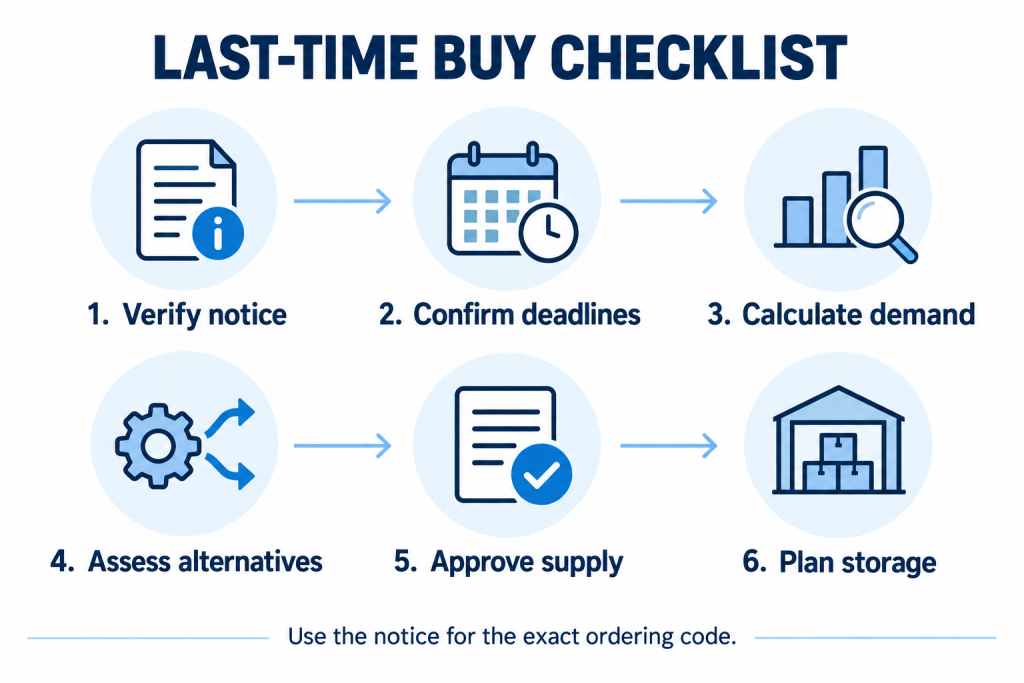
3. Calculate the Net Requirement, Not Just Next Year’s Production
Choose a coverage endpoint first: completion of the existing program, qualification of a redesign, or the agreed service-support horizon. Keep those scenarios separate. Buying through an uncertain redesign date and buying for the entire remaining fleet life are different decisions.
A useful working calculation is:
Net requirement = remaining production + service spares + qualification/test consumption + justified loss allowance − usable unallocated stock − confirmed incoming supply.
Use the same component unit throughout, and set a floor of zero. Count only stock with the required identity and an acceptable condition; exclude quarantined material and inventory already allocated elsewhere. Remove duplicate purchase-order lines, and check whether an assembly-level spare forecast already includes the component demand you are adding.
Illustrative quantity example—not a forecast or stocking recommendation
| Planning input | Units |
|---|---|
| Remaining production requirement | 1,200 |
| Service and repair spares | 300 |
| Qualification and test consumption | 50 |
| Documented loss allowance | 150 |
| Less usable, unallocated stock | −400 |
| Less confirmed incoming supply | −200 |
| Net requirement | 1,100 |
If the supplier confirms a required order multiple of 250 for this hypothetical offer, 1,100 units would round up to 1,250. The additional 150 units become an explicit excess-stock decision. The example’s allowance and order multiple are invented planning inputs, not industry defaults.
Run low, expected and high demand scenarios with named assumptions: repair history, program extensions, yield losses, and the approved migration schedule. Have the requirement owner sign off the scenario chosen. A blanket percentage cannot replace evidence about the actual program.
4. Compare a Final Buy With a Bridge Buy or an Approved Alternative
- Final buy for the remaining program: assess the demand uncertainty, storage capacity, inspection needs and risk of unused stock before approving the quantity.
- Bridge buy during redesign: tie the quantity to an engineering-owned transition plan, including qualification and a realistic contingency—not simply the date of the first prototype.
- Qualified alternate: confirm the approved replacement and release conditions. A cross-reference or supplier suggestion is a candidate for review, not automatic interchangeability.
- Legacy stock sourcing: when factory ordering is no longer available, review the specific offered lot, source, available records and acceptance requirements rather than assuming all listed stock is equivalent.
Do not infer an imminent discontinuation just because a longevity-program date is approaching. NXP explicitly says participating products are not automatically discontinued when their longevity period expires; its EOL and change-notification policies still apply. Verify the current status and applicable notice rather than inventing a deadline from the program table. Source: NXP Product Longevity.
5. Make the Stock Usable for the Entire Coverage Period
An accepted order does not finish the plan. Assign an owner for receiving inspection, storage, stock allocation and periodic review. Agree the required evidence and any inspection or testing before ordering, especially where independent-channel inventory is involved.
- Preserve ordering-code, lot, date-code and supplier-record links when material is received or repacked.
- Follow the applicable device and packaging requirements for ESD and moisture-sensitive handling; do not assume one storage recipe fits every package.
- Keep accepted, quarantined and allocated quantities separate so the next forecast does not overstate usable stock.
- Review the forecast against actual consumption and approved program changes; record any decision to release reserved material.
Use our date-code and storage-risk guide alongside the CoC and traceability checklist. Neither a recent-looking date code nor a generic certificate, by itself, resolves identity, condition and application acceptance.
6. Keep a One-Page Decision Record
Before approval, the record should contain the exact requested part number; notice reference and revision; both external deadlines; an earlier internal decision date; the coverage endpoint; demand assumptions; usable stock and confirmed supply; the quantity selected; the sourcing route; the acceptance and storage plan; and the names of the engineering, quality and purchasing owners.
For a legacy BOM line such as PC7410MGH500LE or APA600-PQG208M, keep that full code in the request rather than a shortened family name. These links are examples of exact-code enquiry pages—not evidence of a current manufacturer LTB window, an approved alternative or reserved inventory.
Frequently Asked Questions
Is NRND the same as end of life?
No. TI’s definitions, for example, allow NRND parts to remain available for existing designs. Verify the manufacturer’s definition and the exact affected ordering code before treating it as a discontinuation event.
Can delivery happen after the last-time-buy date?
It can when the applicable notice provides a later shipment period and the supplier accepts that schedule. Record both dates and confirm the actual order terms; do not infer them from another product’s notice.
Should we always buy the entire remaining lifetime demand?
No single quantity policy suits every program. Compare remaining demand, repair obligations, storage and acceptance risk with the feasibility and timing of an approved alternative. A bridge buy may serve a different purpose from a full-program buy.
What if the manufacturer ordering window has closed?
Ask the manufacturer or authorized channel about any remaining supply or supported alternatives. If independent sourcing is considered, qualify the actual offer and evidence, and obtain the required engineering and quality approvals. Do not treat an inventory listing as proof of origin or suitability.
Send a Requirement That Can Be Checked
For a ZZX Electronics sourcing enquiry, include the complete manufacturer part number, required quantity, delivery target, relevant EOL notice if available, and your package, grade and documentation requirements. State whether only an exact match is acceptable or an alternate may be submitted for review. Share only the information needed for the enquiry, not confidential design files.
Contact ZZX Electronics about an obsolete or hard-to-find component requirement.
Manufacturer References
- Texas Instruments: Product lifecycle and status definitions
- Analog Devices: Product Life Cycle Information and obsolescence information
- Microchip: Product/Process Change and End of Life Notification Policy
- NXP: Product Longevity program requirements
Sources checked September 14, 2026. This article is a procurement planning checklist, not an engineering substitution approval or a promise of supply. The numerical example is hypothetical. Follow the latest applicable manufacturer notice and your organization’s acceptance process. Images are AI-generated educational illustrations, not photographs of specific offered inventory.