A short enquiry such as “Please quote 100 pieces” can produce several prices that are impossible to compare. One supplier may quote material already in its warehouse; another may still need to obtain it. Inspection, packaging, documentation and shipping may also be different. For obsolete electronic components, a useful RFQ makes those differences visible before a purchase order is issued.
This guide provides a practical request-for-quotation checklist and a copyable enquiry template for procurement teams buying discontinued or hard-to-find parts. It is a purchasing workflow, not a substitute for engineering approval or your quality team’s acceptance requirements.
Quick Answer: What Should an Electronic Component RFQ Include?
Include the complete manufacturer part number, manufacturer, quantity, required arrival date and destination, acceptable condition, packaging, lot restrictions, documentation, and any inspection or testing requirements. Ask the supplier to identify exceptions and separate confirmed stock from material that still needs sourcing. Request a written quotation with currency, quantity basis, validity and the point from which the stated lead time starts.
A complete RFQ does not guarantee availability or authenticity. Its purpose is to give your purchasing, engineering and quality teams the same information when evaluating an offer.
1. Identify the Exact Part, Not Just the Product Family
Copy the complete ordering code from your approved bill of materials or other controlled record. Preserve suffixes, hyphens, slashes and relevant letter case. Give the manufacturer separately rather than asking a supplier to infer it from a shortened code. If your internal item number differs from the manufacturer’s code, label both clearly.
Attach the applicable datasheet revision or drawing when it is needed to resolve an ambiguity. For legacy military or customer-controlled parts, distinguish a drawing number from a manufacturer’s commercial ordering code. Do not assume that a similar-looking number is an approved substitute.
State whether alternatives are allowed. A useful instruction is: “Quote the requested ordering code first; list any alternatives separately for engineering review.” Our part-number suffix guide explains why apparently minor suffix differences should not be silently removed.
For examples of complete ordering codes, compare our listings for CD54HCT175F3A, LM111JG and CY7C346-35RMB. These are different components, not substitutes. Include the exact manufacturer and full ordering code in each RFQ, and request current lot-specific availability and documentation.
2. Separate Quantity, Dispatch Date and Required Arrival
Give the immediate requirement and, if useful, an optional forecast separately. Make clear whether you can accept partial shipments or must receive the entire quantity together. State the required arrival date and destination country or postal region, not simply “urgent.”
Ask what the quoted lead time means: time until material is available, time until dispatch, or estimated transit. Analog Devices’ ordering FAQ, for example, describes lead time in terms of availability for shipment and notes that quantity can affect it. That does not make it a guaranteed delivery date to your facility.
For an independent-source offer, also ask whether time is needed to acquire the lot, complete agreed inspection, obtain documents or release it for shipment. Record the supplier’s answer rather than assuming all of those activities are included.
3. Ask What “In Stock” Means for This Specific Offer
Request confirmation of whether the quoted quantity is physically held by the quoting supplier, held by another identified supply source, or still subject to sourcing. Ask when the quantity was last checked and whether it has been reserved for your order. A search result or inventory listing alone should not be treated as an allocation.
Specify the acceptable condition and ask for any exceptions in writing. If you require unused material, do not let a vague description such as “good condition” replace that requirement. Ask the supplier to disclose known rework, repackaging or recovery from previously assembled equipment rather than treating those conditions as equivalent.
Lot-specific photographs can help reconcile labels, packaging and markings with an offer, but photographs are not a substitute for provenance or an agreed inspection plan. If photographs are generic, the quotation should say so.
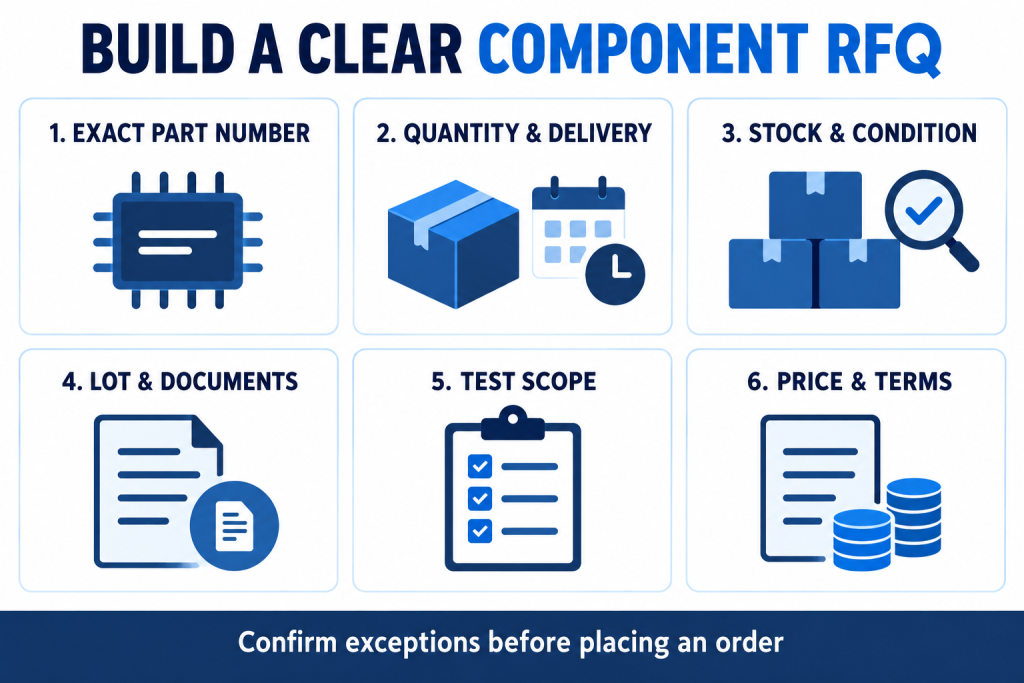
4. Define Packaging, Lot Restrictions and Records
Separate the device package from the shipping carrier. A package designation identifies the component’s physical format; a reel, tube or tray describes how units are supplied. Ask about order multiples, whether the carrier is original or repacked, and any assembly-line handling constraints that matter to your team.
Include date-code or single-lot restrictions only when they are actual acceptance requirements. Ask for the offered date codes and quantities per lot, and have your quality team review exceptions. An older date code alone does not describe storage history, and a newer one does not establish authenticity. See our date-code and storage guide for that distinction.
List the records you require and ask which are available for the offered lot. Distinguish a supplier-issued Certificate of Conformance from a manufacturer-issued record, and distinguish a traceable document from a general company certificate. Our CoC and traceability checklist covers the questions in more detail.
5. Specify the Test Scope Instead of Asking for “Tested Parts”
“Tested” is incomplete without a description of the work. Ask which inspections or electrical checks are proposed, who will perform them, which lot and sample quantity they cover, and what report will be supplied. Clarify whether testing is included in the quoted price or is an additional service.
Your engineering or quality team should define the applicable test conditions, acceptance limits and treatment of a failed result. Do not turn a generic checklist into a universal test plan: a relay, memory device and programmable logic device may need very different evaluation.
Also distinguish sample evaluation from release of the whole lot. A report for a different lot or a small sample should not be represented as proof that every delivered unit was tested. Agree how the report will identify the shipment before you depend on it for acceptance.
6. Compare the Full Written Offer
Keep price, quantity basis, delivery, documentation and evaluation scope together. TI’s quote request and response documentation is a useful manufacturer example: its format distinguishes the requested product and quantity from response fields such as currency, validity, minimum quantity, order increment and estimated lead time. Each supplier’s actual quotation and terms must still be reviewed on their own.
Request a breakdown of unit price and any separately charged inspection, testing, packing or freight. Ask the supplier to identify cancellation, return and acceptance conditions before you place an order. Do not infer them from the unit price or treat an RFQ acknowledgement as an accepted purchase order.
A Simple Comparison Example
Hypothetical example, not a ZZX quotation: you need 100 pieces. Offer A is USD 20 per piece, with USD 300 for the agreed inspection and USD 50 freight, giving a stated subtotal of USD 2,350. Offer B is USD 22 per piece with that same inspection scope included, plus USD 50 freight, giving USD 2,250. Taxes, duties and other charges are excluded from this illustration.
Offer B has the lower comparable subtotal despite its higher unit price. That comparison is useful only if the exact part, condition, quantity, scope and delivery commitment are also acceptable. A lower subtotal cannot compensate for an unapproved variant or undocumented exception.
Copyable RFQ Template
Replace the bracketed items with your actual requirements. Delete fields that do not apply; do not fill unknown details with guesses.
Subject: RFQ — [complete manufacturer part number] — [quantity] — required by [arrival date]
Requested item: [manufacturer and complete ordering code]
Reference: [BOM item / drawing / datasheet revision, if applicable]
Quantity: [immediate quantity]; [partial shipments allowed or not]
Delivery: [required arrival date and destination]
Condition and carrier: [requirements]
Lot or date-code restrictions: [requirements, or request offered details]
Required records: [CoC issuer, traceability and other specified documents]
Inspection/testing: [approved scope, or request a separate proposal]
Alternatives: [not permitted / separate offer for engineering review]Please confirm the stock location and availability status, offered lot details, any exceptions, currency, quantity basis, quote validity, extra charges, and dispatch lead time including its starting point. Please identify which documents and inspection results will accompany the shipment. Do not substitute a different ordering code without written approval.
Check the Sourcing Channel Before Releasing an Order
Check the manufacturer and its authorized distribution network first, including any listed legacy-product channels. TI’s authorized-distributor guidance warns about risks outside its network and limits its warranty and support accordingly. ADI’s distributor directory likewise explains the support associated with purchases through authorized distributors.
If you consider an independent source, establish the offered lot’s evidence, your acceptance requirements and the support actually being provided. Independent sourcing is not the same as manufacturer-authorized distribution; an inspection report does not create manufacturer authorization or reinstate factory warranty coverage.
If the enquiry is part of an end-of-life program, use the demand and deadline checks in our last-time-buy planning guide before turning a one-off quotation into a long-term inventory commitment.
Frequently Asked Questions
Can I request a quote with only a part number and quantity?
Yes, that can start an availability discussion. To compare offers or approve a purchase, add the manufacturer, delivery requirement, acceptable condition and any mandatory documents or tests. Ask the supplier to flag information that remains unconfirmed.
Does an RFQ reserve the listed stock?
Do not assume it does. Request explicit confirmation of any reservation, the allocated quantity and how long it remains valid. A price-validity date and a stock reservation are different commitments.
Should I accept a similar part number if the original is unavailable?
Only after the appropriate engineering review and approval. Ask for the alternative as a separate line with its exact code and documented differences; do not allow a supplier to shorten or replace your original request silently.
Is a supplier CoC enough to prove authenticity?
No single document should be treated as conclusive proof by itself. Review the issuer, the lot it covers and the supporting traceability, then apply your quality team’s risk-based acceptance process. Documents and inspections have specific scopes and limitations.
Apply the checklist to an exact memory ordering code
For an MR2A16AVYS35 RFQ, state the complete Everspin code, quantity, required delivery date, acceptable date-code range, packaging condition and documentation requirements. Use the replacement compatibility checklist if alternatives may be proposed. Ask the supplier to identify every deviation in writing rather than silently accepting a related memory part.
Send a Clear Enquiry to ZZX Electronics
For an obsolete or hard-to-find component enquiry, contact ZZX Electronics with the exact ordering code, manufacturer, required quantity and delivery target. Include your condition, documentation and testing requirements so the response can address the actual need. Ask for lot-specific availability and any exceptions in the written quotation.
References
- Texas Instruments — Quote Request/Response fields
- Analog Devices — Ordering FAQs and lead-time terminology
- Texas Instruments — Authorized distributor guidance
- Analog Devices — Authorized distributor directory
Sources checked September 21, 2026. This article provides general procurement guidance. It does not certify a particular lot, approve a substitute, or replace manufacturer instructions, your organization’s quality procedures or the agreed purchase terms. Images are AI-generated editorial illustrations, not photographs of offered inventory or component-handling instructions.