Quick answer
A pin-compatible IC is not automatically an approved drop-in replacement. Matching pin positions is only one part of the review. The responsible engineer should compare operating conditions, interface levels, timing, package dimensions and the application’s qualification requirements before procurement releases a substitute.
When an obsolete or hard-to-find component is unavailable, an alternative may keep a project moving. However, a supplier’s cross-reference is a candidate for evaluation—not proof that the device will work in your equipment. The checklist below is a suggested procurement workflow, not a manufacturer-issued equivalence declaration.
1. Define which problem you are solving
There are two different sourcing routes:
- Exact-part sourcing: obtain the approved manufacturer and complete ordering code already specified on the bill of materials.
- Substitution: propose a different manufacturer, device, package or grade and obtain an engineering decision before purchase.
Keep these routes separate in the RFQ. If substitutes are permitted, identify them as proposals. Do not let a quotation silently turn an alternative into the approved BOM item.
The exact-part route still requires checks on identity, condition and documents. A technically suitable alternative still requires checks on those same procurement risks. Neither route removes the other workstream.
2. Example: a shared logic function does not establish interface compatibility
Texas Instruments’ combined HC175/HCT175 datasheet describes quad D-type flip-flops, but specifies different operating requirements: HC types operate from 2 V to 6 V, while HCT types operate from 4.5 V to 5.5 V. HCT input limits include a 2 V minimum high-level input and a 0.8 V maximum low-level input. [1]
The procurement lesson is an inference from those specifications: sharing a function and pinout does not remove the need to check the actual supply and signals driving the device. Compare guaranteed limits at the relevant conditions, not just a familiar family name.
For an exact ordering-code example, see the ZZX listing for CD54HCT175F3A: CD54HCT175F3A product listing
This example is not a recommendation to substitute HC for HCT, and does not assert that either family is obsolete.
3. Example: related comparators can have different temperature coverage
TI’s LM111/LM211/LM311 datasheet specifies temperature ranges of −55°C to +125°C for LM111, −40°C to +85°C for LM211 and 0°C to +70°C for LM311. [2]
A related comparator with narrower temperature coverage should not be assumed acceptable for equipment requiring the original grade. Review the exact orderable package and the full electrical specifications as well as temperature.
The ZZX LM111JG listing provides a specific ordering-code reference: LM111JG product listing
Neither example proves interchangeability. Manufacturer specifications describe a device; application approval belongs to the customer’s responsible engineering process.

Memory example: compatible timing is only one check
MR2A16AVYS35 is a 4 Mbit MRAM with SRAM-compatible timing. That interface description does not make it an SRAM or approve a replacement for a different density, package or temperature grade. Compare the exact-code data and the offered lot; EV2A16AMNYU35 is another MRAM example with its own ordering and qualification requirements. No interchangeability between these examples is asserted.
4. Build a comparison record before approving a substitute
Use one row per requirement, with separate columns for the original part, candidate part, source document, difference and acceptance decision. At minimum, cover:
- Identity: complete manufacturer ordering code, package option and document revision.
- Form and fit: footprint, dimensions, pin numbering, orientation and assembly compatibility.
- Function: operating mode, reset behavior, control signals and expected system behavior.
- Electrical interface: supply conditions, input and output limits, loading and relevant protection requirements.
- Timing: parameters that matter to the actual circuit, with their test conditions.
- Environment and qualification: required temperature range and the contractual or customer-specific grade.
- System dependencies: firmware, programming or configuration changes where relevant.
Do not turn a blank comparison cell into a pass. Record it as unresolved and ask engineering whether further evidence or testing is necessary. Equally, do not reject every difference automatically: document why a difference is acceptable for this application, if engineering determines that it is.
5. Agree on the acceptance plan
Before buying a production quantity, ask the responsible engineer to define which document checks and application tests are needed, who approves the result and which equipment revision the approval covers.
A supplier inspection report and an application compatibility assessment answer different questions. The first may address the supplied material within an agreed inspection scope; the second addresses whether a candidate meets the customer’s design requirements. Avoid using one as a substitute for the other.
For a controlled release, retain the comparison, source documents, relevant test results and approval. Link the purchase order to the approved candidate code and state whether later substitution requires a new review.
6. Put the decision into the RFQ
Suggested wording:
“Please quote the exact manufacturer ordering code listed below. Any alternative must be identified separately with its complete ordering code and supporting manufacturer documents. Do not substitute without our written engineering approval. Please state available quantity, condition, lot information and the documents or inspection services actually included in the offer.”
For the complete purchasing checklist, read: RFQ checklist
For ordering-code checks, read: Part-number suffix guide
Frequently asked questions
Is pin compatibility enough to approve a replacement? No. It addresses pin arrangement, not the complete electrical, mechanical or qualification requirements of the application.
Can a cross-reference replace the original datasheet? Use it to identify a candidate. Build the approval record from the exact devices’ manufacturer documents and the application’s requirements.
Should purchasing accept a different temperature grade? Only when the responsible engineer has evaluated the application’s requirements and approved the exact candidate. A family resemblance is not sufficient.
Does this guide declare the listed parts interchangeable? No. The examples illustrate why comparison is necessary; no substitute pairing is approved here.
Need an exact-part quotation?
Send ZZX Electronics the complete ordering code, quantity and delivery requirement, and state whether alternatives may be proposed for review. Request written confirmation of current availability and the documents or inspection scope included in the quotation: Contact ZZX Electronics
Sources and technical references
[1] Texas Instruments, SCHS160C, CD54HC175/CD74HC175/CD54HCT175/CD74HCT175. Page 1 and DC electrical specifications. Checked October 5, 2026. Manufacturer datasheet
[2] Texas Instruments, SLCS007K, LM111/LM211/LM311 Differential Comparators. Electrical-characteristics temperature note and device description. Checked October 5, 2026. Manufacturer datasheet
Disclaimer: This article offers a procurement review framework. It does not approve a component substitution or replace manufacturer specifications, application validation or customer-specific qualification requirements.
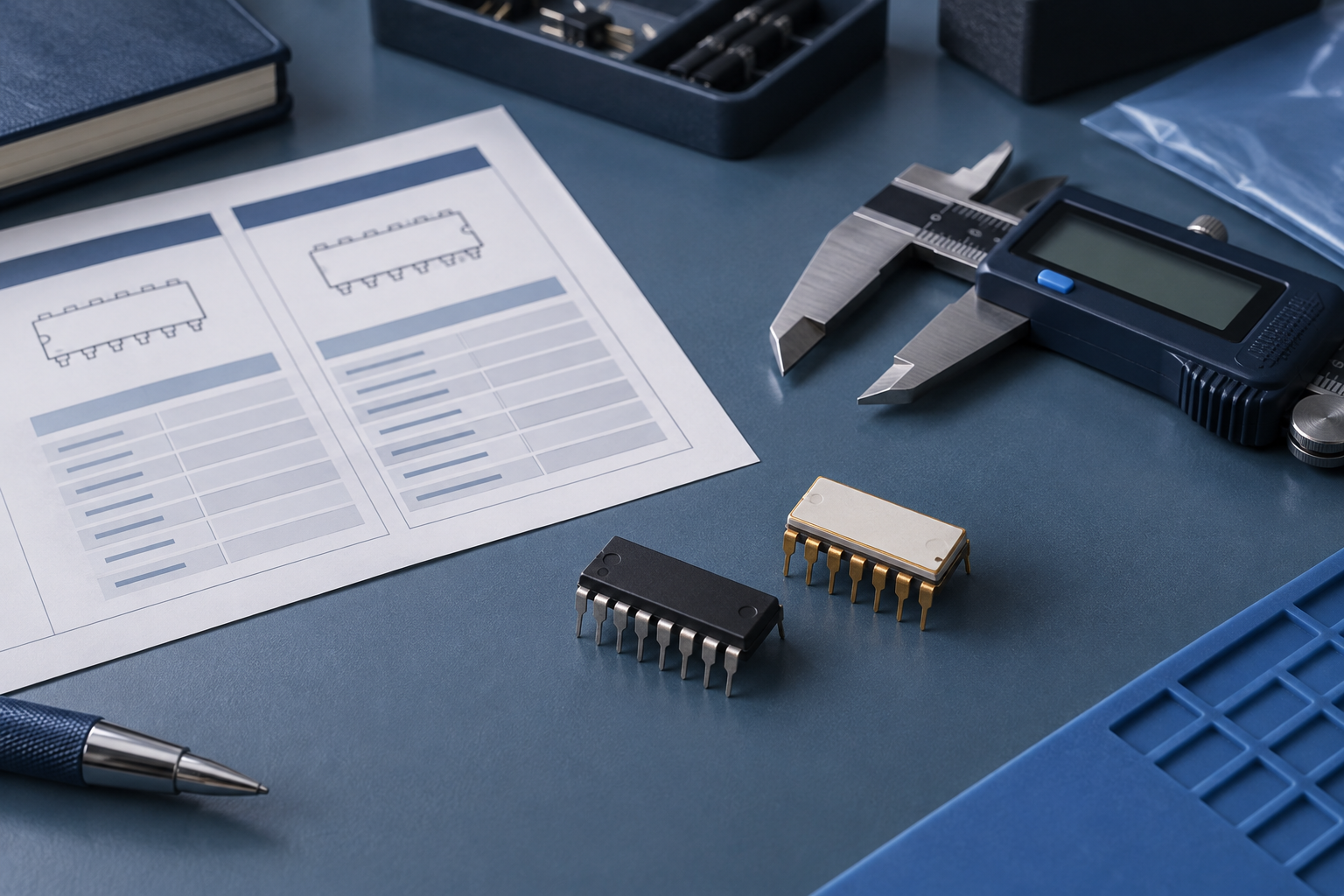
Images are AI-generated editorial illustrations, not photographs of offered stock, ZZX facilities or completed compatibility tests.