Quick Summary for Buyers
The XC2C384-10FTG256I is a 384-macrocell CoolRunner-II CPLD originally manufactured by Xilinx (acquired by AMD in 2022). In January 2024, AMD officially announced the end-of-life (EOL) for the entire CoolRunner-II CPLD family, with final orders accepted through June 29, 2024. All units available in the market today come from post-EOL channel inventory or independent sourcing partners.
At the article’s original publication, ZZX Electronics documented 258 pcs of XC2C384-10FTG256I carrying Date Code 2113 (Week 13 of 2021). The live XC2C384-10FTG256I part page is the current source for available quantity, date code, datasheet, and RFQ details because stock and lots can change. ZZX does not act as an authorized distributor for AMD/Xilinx, and this article is sourcing-focused rather than an engineering certification.
Quick Answer: What Buyers Should Verify for XC2C384-10FTG256I
XC2C384-10FTG256I is an industrial-temperature AMD/Xilinx CoolRunner-II CPLD with 384 macrocells in the FT256 package and a -10 speed grade. Because the CoolRunner-II family is discontinued, buyers should verify the complete suffix, package and speed grade, lot/date-code evidence, ball and marking condition, programming requirements, traceability documents, and engineering acceptance before use. Use the live part page above for current stock rather than treating the publication-date lot as real-time inventory.
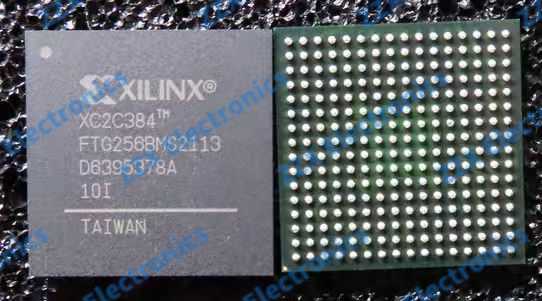
What Is XC2C384-10FTG256I?
The XC2C384-10FTG256I is a member of the Xilinx CoolRunner-II CPLD family, a low-power 0.18 μm CMOS programmable logic device line originally released in the early 2000s. It targets industrial and embedded applications where small footprint, low standby current, and deterministic logic behavior are needed.
Key characteristics drawn from the official AMD/Xilinx CoolRunner-II datasheet:
- Macrocells: 384
- Function Blocks: 8 (each with a 40 × 56 P-term PLA and 16 macrocells)
- User I/O pins: 212
- Equivalent gates: approximately 9K
- Maximum operating frequency: 125 MHz (for the -10 speed grade)
- Core voltage: 1.8 V
- I/O standards: Multiple JEDEC standards, with 1.5 V compatibility via Schmitt-trigger inputs
- Package: FT256 — 256-ball FBGA, 1.0 mm pitch, 17 × 17 mm
- Temperature range: Industrial (-40 °C to +85 °C)
- Programmability: In-System Programmable (ISP) via JTAG (IEEE 1149.1 / 1532)
Part number breakdown:
XC2C384-10FTG256I
 │   │   │  │  │  └─ I   = Industrial temperature grade
 │   │   │  │  └──── 256 = ball count (256-ball BGA)
 │   │   │  └─────── G   = Pb-free / RoHS lead-free
 │   │   └────────── FT  = Fine-pitch BGA package
 │   │   └────────── -10 = Speed grade (10 ns propagation delay)
 │   └────────────── 384 = 384 macrocells
 └────────────────── XC2C = CoolRunner-II family
Distinctive architectural features include DataGATE (selective input gating for power reduction), CoolCLOCK (combined clock-divide and DualEDGE flip-flop for synchronous operation at lower switching frequency), and I/O banking for mixed-voltage interfacing.
Lifecycle Considerations
On January 1, 2024, AMD formally announced the end-of-life of the XC9500XL, CoolRunner, and CoolRunner-II CPLD families, along with the Spartan-II and Spartan-3 FPGA families. The announcement is documented in AMD’s official product discontinuation notice and has been widely reported across the electronics industry. Final orders for affected devices were accepted through June 29, 2024.
The XC2C384-10FTG256I, as a member of the CoolRunner-II family, falls within the scope of this discontinuation. No new wafer production or factory-direct fulfillment is currently available from AMD for this device. All sources of supply going forward are limited to:
- Authorized distributor inventory remaining from final orders placed before the June 2024 cutoff
- Channel and aftermarket inventory held by independent stocking specialists
- End-customer surplus released back into the market
AMD has communicated that demand for these legacy parts has been declining for years and that maintaining the underlying 0.18 μm process line was no longer economical. For active and sustainment programs, this means lifecycle uncertainty is no longer hypothetical — supply will continue to tighten as remaining authorized stock is drawn down, and pricing volatility on the aftermarket can be expected.
Procurement teams running programs that still call for XC2C384-10FTG256I should confirm the current lifecycle status directly with AMD and the customer’s engineering team before placing orders, and should consider a structured last-time-buy or staged sourcing plan if multi-year support is required.
Current Sourcing Challenges
With AMD’s CoolRunner-II family officially discontinued, the supply environment for XC2C384-10FTG256I has the following characteristics:
- Authorized distributor stock is shrinking and uneven. Some distributors still show inventory online, but quantities, date codes, and country-of-origin information can vary significantly between listings. Lead times for replenishment are typically marked as “not available.”
- Aftermarket and broker stock is the dominant source. This carries the usual risks associated with legacy CPLD sourcing: refurbished units, mixed date codes, repackaged trays, and in worst cases, counterfeit parts re-marked from lower-grade or unrelated devices.
- Date codes are mostly older than 2022. Because production wound down well before the 2024 EOL announcement, most legitimate stock in circulation carries date codes from 2018-2022. Units claiming much newer date codes warrant additional scrutiny.
- Industrial-grade units (the “I” suffix) are scarcer than commercial-grade. Industrial temperature range is required for many legacy designs in automotive, defense, and harsh-environment applications, which keeps demand persistent even as supply declines.
These dynamics make verified inventory with traceable date codes and original packaging materially more valuable than spot-market listings.
ZZX Inventory Information
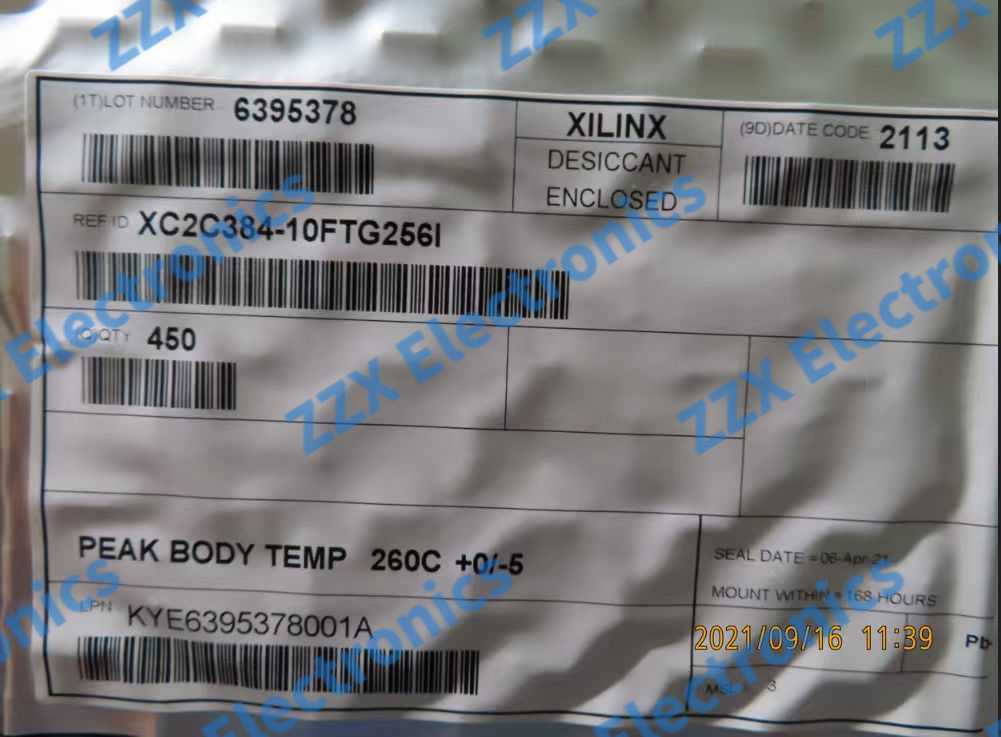
The original inspection example documented in this article recorded the following lot information for XC2C384-10FTG256I:
- Quantity available: 258 pcs
- Date Code: 2113 (Week 13 of 2021)
- Manufacturer marking: Xilinx (pre-AMD acquisition era marking)
- Packaging: Original anti-static trays with manufacturer markings; sealed condition where applicable
- Temperature grade: Industrial (-40 °C to +85 °C), as indicated by the “I” suffix
Inspection photographs of the actual stock are available on request, including chip surface markings and packaging label details for date code and traceability review. Quantities reflect verified information at the time of publication and are subject to change as orders are placed. Buyers requiring exact lot-level traceability or country-of-origin documentation are encouraged to request a sample order before committing to production quantities.
How Buyers Can Verify Authenticity
Because XC2C384-10FTG256I is now an end-of-life device sourced almost entirely from the aftermarket, authenticity verification is the single most important step in any procurement decision. ZZX recommends the following seven-step verification process for legacy CPLDs:
-
Inspect the chip surface marking. Legitimate Xilinx CoolRunner-II devices use consistent industrial laser marking. The part number, date code, country of origin, and lot identifier should appear in a uniform font, sharp edges, and the correct relative positions. Hand-applied ink, partially worn markings, off-center text, or signs of solvent residue (which can indicate re-marking) are major red flags.
-
Verify the date code matches the package condition. A device claiming a recent date code (post-2022) but exhibiting yellowed packaging, oxidized BGA balls, or aged tray material is likely re-marked. Conversely, an older date code (2018-2021) with pristine packaging may be legitimate long-term storage or may indicate repackaging — both warrant follow-up.
-
Check the FBGA ball condition. Original solder balls should be uniform in size, fully spherical, and free of oxidation, flux residue, or rework signs. Reballed devices often show slightly irregular ball geometry, residual flux, or evidence of underfill removal.
-
Confirm packaging label consistency. Original Xilinx packaging includes printed labels with the part number, lot number, date code, country of origin, and quantity, plus barcode encoding that should match the printed values. Handwritten or hand-applied labels are a warning sign.
-
Confirm lot and date code consistency across the shipment. All units within a single tray should share the same lot number and date code. Mixed lots in a single tray almost always indicate aftermarket repackaging rather than original factory packaging. For programs requiring single-lot builds, this verification is a hard requirement.
-
Request a Certificate of Conformance and inspection report. ZZX provides COC documentation for inventory held under verified traceability. For programs with stricter requirements, third-party testing services such as decapsulation, X-ray inspection, or electrical sampling can be coordinated.
-
Order a sample before committing to production quantities. For first-time purchases or new supplier relationships, ordering a small sample for engineering inspection before placing a production order is inexpensive insurance — particularly for end-of-life devices where re-orders cannot easily correct sourcing mistakes.
Applied consistently, these steps address the great majority of counterfeit and quality risks in the legacy CPLD market.
Procurement Strategies for Legacy Components
With XC2C384-10FTG256I now firmly in the post-EOL phase, the right procurement strategy depends on the customer’s program horizon:
-
Active production with a planned redesign. Secure enough inventory to cover production until the redesign is qualified and released. Avoid building speculative buffer beyond that point — long-term storage of CPLDs requires controlled conditions and the device value declines as alternative parts become better characterized.
-
Active production with no redesign planned. Run a lifetime-buy calculation based on annual usage and program horizon, then secure the full buffer in a single sourcing round to lock in date code consistency and avoid the risk of supply gaps later. Discuss multi-tier sourcing with your supplier — splitting a lifetime buy across two or three verified suppliers reduces concentration risk.
-
Sustainment and field-replacement programs. Maintain a small buffer of verified units, refresh the buffer periodically as field replacements are consumed, and prioritize lot consistency over price. For programs running another five to ten years on legacy XC2C384-based designs, periodic small purchases from verified sources are typically more economical than a single very large lifetime buy.
-
Spot needs and one-off repairs. Verified single-source inventory with full traceability documentation is the right answer. Avoid the cheapest spot listings.
In all cases, the customer’s engineering team should validate any sourced material under the program’s specific qualification process before committing to use.
A Note on Engineering Migration
For long-term designs, customers may need to evaluate newer programmable logic families based on official manufacturer documentation. ZZX Electronics does not provide engineering migration certification. Any replacement, redesign, or qualification decision should be verified by the customer’s engineering team. Please refer to the manufacturer’s official lifecycle and migration documentation for technical guidance.
How ZZX Electronics Can Support
ZZX Electronics specializes in sourcing obsolete and hard-to-find electronic components, including discontinued CPLDs, FPGAs, and other programmable logic devices from legacy Xilinx, AMD, and Microchip product lines. For XC2C384-10FTG256I and related CoolRunner-II family parts, ZZX can assist with the following:
- Inventory verification with photographs — chip surface markings, packaging labels, and tray condition documented before purchase.
- Lot and date code traceability checks — confirmation that quantities match a consistent lot, with documentation provided.
- Sample order coordination — small-quantity engineering samples available for inspection and qualification testing.
- Documentation support — Certificate of Conformance, inspection reports, and packaging condition records on request.
- Procurement risk consultation — guidance on lifetime-buy sizing, single-source versus multi-source strategies, and storage recommendations for legacy CPLDs.
Three steps any buyer can take today:
- Request a stock availability check for current XC2C384-10FTG256I inventory and date code.
- Request inspection photographs of the actual stock before placing an order.
- Request a sample for evaluation to validate authenticity and packaging condition before committing to production volume.
Disclaimer
This article is based on publicly available manufacturer documentation and ZZX Electronics’ sourcing experience. It does not constitute engineering certification or a guarantee of component compatibility.
ZZX Electronics serves as an independent sourcing partner for obsolete and hard-to-find components. We do not certify replacements on behalf of original component manufacturers. Any decisions regarding component selection, redesign, migration, or qualification must be made and verified by the customer’s engineering team under their specific application conditions.
Inventory quantities, lot codes, and date codes referenced in this article reflect verified information at the time of publication and are subject to change.